What is Concussion?
Concussion, also known as “mild” Traumatic Brain Injury (mTBI), is caused by a single impact to the head or body and temporarily impairs brain function. This impact creates abnormally strong rotational forces to the brain (rotational brain injury), causing damage to brain nerve cells and the shearing of brain cells.
Concussion is the most frequent diagnosed form of brain injury, especially in contact sports like football and rugby, but is often seen as the least serious. The immediate effects of a concussion are becoming well recognised.
All concussions are serious, it can be potentially career-ending and life-changing for every player in sport. In the vast majority of concussions, the individual appears to make a full recovery and makes a staged return to normal life and sport.
What are the symptoms of a Concussion?
Concussion produces symptoms that an individual is aware of (e.g. headache, dizziness) or signs that another person can see (e.g. balance disturbances).
Symptoms of concussion can be both physical and cognitive, and changes in sleep and emotions.
Physical symptoms:
Cognitive symptoms:
Sleep symptoms:
Emotional symptoms:
Loss of consciousness (being knocked out) occurs in less than 10% of concussions. It is not required to diagnose a concussion.
How Long do Concussions Last?
Changes in white matter, brain connections and blood flow can persist a year or more after a concussion. Returning to play too soon can increase the risk of sustaining further injury and subsequent symptoms, requiring a prolonged period of recovery. Repetitive concussions with sub-concussions lead to long-term progressive symptoms of brain injury including Chronic Traumatic Encephalopathy (CTE).
A concussion can last from hours to days and depends on each individual case. Early recognition is key. Initially, there is a need for 24-48 hours of rest, followed by a gradual resumption of everyday activity, and then a graduated return to cognitive and physical activity. For more serious symptoms, the period of rest should be extended and a reduction in physical activity recommended.
While the more serious concussions can last anywhere from weeks to months, it is vitally important to confidently know the signs of a concussion and to contact your healthcare professional for the correct guidance and advice.
There are risks in returning to play too soon after a concussion. Another impact has the potential to be fatal – Second Impact Syndrome, although this is rare, and most common among children and youth players.
How to treat concussions
Players with any concussion symptoms following a head injury must be removed immediately from play or training. They must not take part in any physical activity until all concussion symptoms have cleared.
An adult should stay with the player for 24 hours after the concussion in case symptoms worsen or new symptoms develop.
When can you return to play after a concussion?
No one should return to play on the same day with suspected concussion. No one should drive, operate machinery or drink alcohol after a suspected concussion.
You should be symptom-free and have returned to normal school or work activities, as well as have evidence of completing a staged returning to learning and returning to play protocol.
It is recommended that players wait at least 30 days after a concussion to return to play.
What happens if you play sport with a concussion?
If a concussion is sustained during sport, the player should be removed from play as soon as they are suspected of having a concussion. Those who continue to play after suffering a concussion are more likely to have a higher number of symptoms and more severe symptoms, compared to those who stopped playing immediately after their injury.
Data showed that athletes who played for just 15 minutes after sustaining a concussion took, on average, 25–28 days longer to recover than players who were removed from play immediately.
How Frequent is Concussion in Sport?
More than 80% of concussions are diagnosed the next day, or several days later and it is suggested up to 90% of concussions in sport go unreported. Estimates from the US, where there is a much greater awareness of brain trauma, records of head injuries and extensive data sets around concussions suggest that around 50% of concussions go unreported to coaches, medical staff or parents.
Every year in English professional rugby, concussion accounts for 28% of all injuries, and in football, as many as 22% of all injuries are head-related and concussions. Putting that into context:
Likely concussion and brain injuries for women in England playing football and rugby is x 13 times greater than the number of women diagnosed with breast cancer in the UK each year.
Likely concussion and brain injuries for men in England playing football and rugby is x 39 times greater than the number of men diagnosed with prostate cancer in the UK each year.
Growing awareness, legal action and media interest have meant that brain injuries in football, rugby, hockey and other contact sports are being taken more seriously by their regulatory bodies.
How to reduce concussion in sport
There are a number of ways that sports are trying to reduce concussions during play. They include:
- Limiting the amount of contact during practice
- Educating players on concussion and sub-concussions
Unfortunately, when it comes to protective headgear in sport, the focus is not on reducing rotational forces to the brain and sub-concussions , but rather general head impact and skull protection.
In a 2022 Ted Talk, Dr. Emer MacSweeney, BSc (Hons), MRCP, FRCR, and Consultant Neuroradiologist, explained that “effective brain, as opposed to skull, protection is desperately needed.”
This is where Rezon Halos® headbands for concussions and sub-concussions come in. Halos® headbands are proven to reduce the damage of rotational forces to the brain by 61%.
Sub-Concussions
What is a sub-concussion? It is an impact that damages brain cell function, but does not produce overt signs or symptoms. Sub-concussions go largely unnoticed.
Are sub-concussions serious? Yes. Repetitive, sub-concussive impacts cause damage to the brain and lead to neurological illness later in life. The risk and severity of CTE is not caused primarily by single, big hit concussions, but by multiple sub-concussions.
The force to the brain to cause a concussion is 2-4 times greater than for a sub-concussion, but sub-concussions are over 500 times more frequent.
Is a sub-concussion only from heading a football? No. They can come from head-to-head, head-to-ball and head-to-ground impacts. In football, only 13% of head impacts come from the ball.
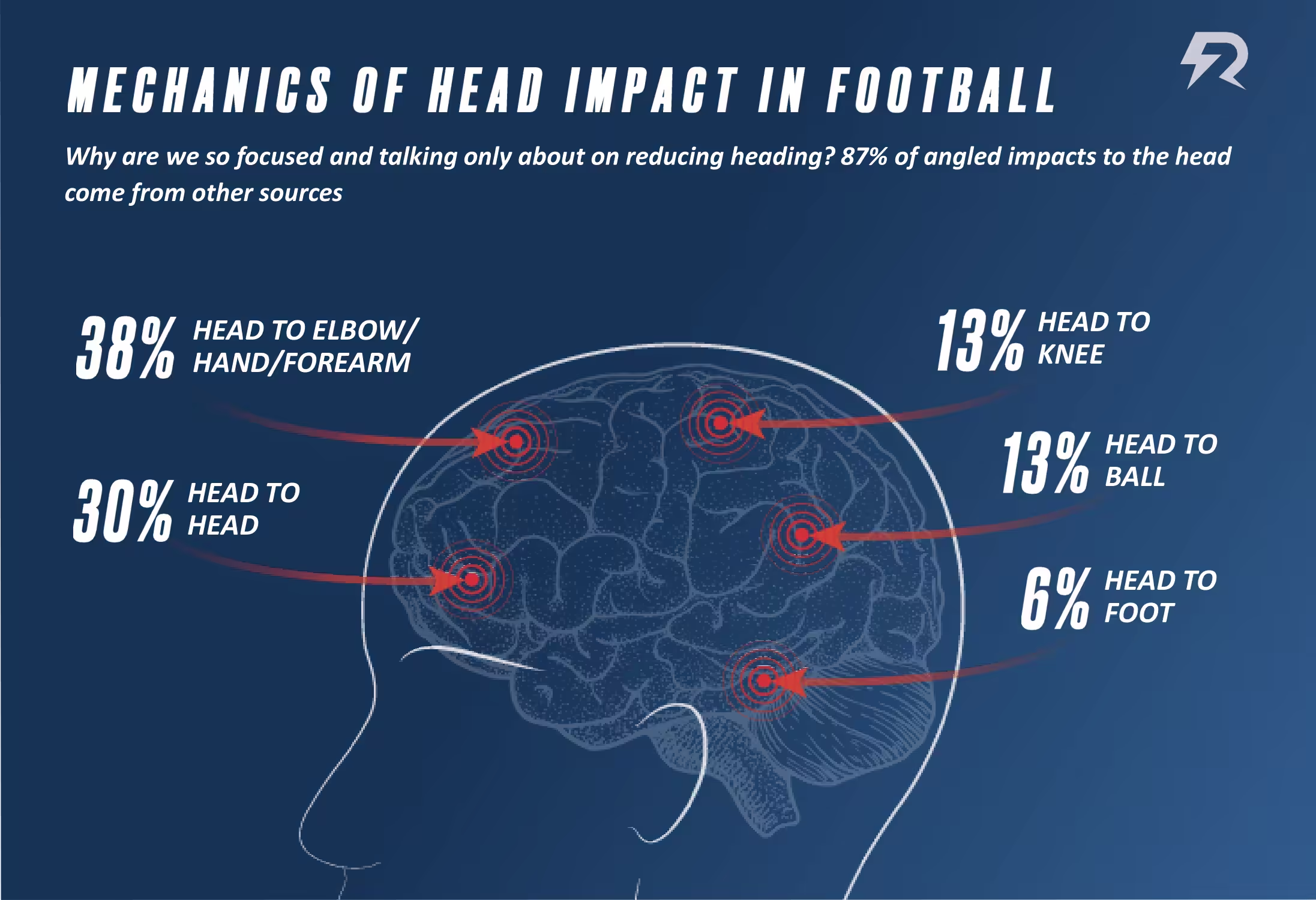
Statistics from Biomechanical investigation of head impacts in football, 2005.
Concussion FAQs
Here you can find answers to some of the more common questions surrounding concussion.
Summary
Concussion and sub-concussion accelerate the progression to negative cognitive, psychiatric, or mental health outcomes. Concussion and sub-concussion can also lead to physical, emotional, and sleep problems.
Research Highlights:
- There’s a significant association between a history of concussion and lower extremity injury, especially lateral ankle sprain, knee injuries and muscle strains. All athletes of all levels in sport have a greater risk of lower-body injury issues for more than a year following a sport-related concussion. In some cases, this risk is as high as 67% [3].
- Those who have a history of three or more concussions have a five-fold increased risk of developing mild cognitive impairment in later life [4].
- Those who have lost consciousness due to sustaining a head injury in their 50s or younger can experience exacerbated or accelerated dementia symptoms [5].
- Lifetime Traumatic Brain Injury and Cognitive Domain Deficits in Late Life: The PROTECT-TBI Cohort Study. Matthew J. Lennon, Helen Brooker, Byron Creese, Tony Thayanandan, Grant Rigney, Dag Aarsland, Adam Hampshire, Clive Ballard, Anne Corbett, and Vanessa Raymont (2023).
- Leveraging football accelerometer data to quantify associations between repetitive head impacts and chronic traumatic encephalopathy in males, Daneshvar DH, Nair ES, Baucom ZH, Rasch A, Abdolmohammadi B, Uretsky M, Saltiel N, Shah A, Jarnagin J, Baugh CM, Martin BM, Palmisano JN, Cherry JD, Alvarez VE, Huber BR, Weuve J, Nowinski CJ, Cantu RC, Zafonte RD, Dwyer B, Crary JF, Goldstein LE, Kowall NW, Katz DI, Stern RA, Tripodis Y, Stein TD, McClean MD, Alosco ML, McKee AC, Mez J, 2023
- The Influence of Sport-Related Concussion on Lower Extremity Injury Risk: A Review of Current Return-to-Play Practices and Clinical Implications, Avedesian JM, Covassin T, and Dufek JS, 2020.
- Association between recurrent concussion and late-life cognitive impairment in retired professional football players, Guskiewicz KM, Marshall S, Bailes J, McCrea M, Cantu RC, Randolph C, and Jordan BD, 2005.
- A population-based study of head injury, cognitive function and pathological markers, James S-N, Nicholas JM, Lane CA, Parker TD, Lu K, Keshavan A, Buchanan SM, Keuss SE, Murray-Smith H, Wong A, Cash DM, Malone IB, Barnes J, Sudre CH, Coath W, Prosser L, Ourselin S, Modat M, Thomas DL, Cardoso J, Heslegrave A, Zetterberg H, Crutch SJ, Schott JM, Richards M, Fox NC, 2021.