Do I need brain protection if I already wear a scrum cap?
Scrum caps were developed primarily to protect the scalp and ears from superficial injury, cuts and abrasions. Brain protection requires a different protective design objective: reducing the forces transmitted to the brain during concussive and sub-concussive head impacts, particularly rotational forces.
Rezon Halos® is brain protection for rugby, specifically designed to reduce rotational forces transmitted to the brain and the accumulated damage of sub-concussions.
Learn More:
My scrum cap reduces impact. Isn’t that brain protection?
“Impact reduction” can refer to different biomechanical measurements and is often presented without specifying exactly what has been reduced. A large percentage of “impact reduction” does not mean there is an equivalent reduction in the rotational forces associated with brain injury in rugby.
For example, one brand advertises “up to 75% reduction in G-force transfer”. Its published research provides the important context, however. The up-to-75% result is related to linear impact acceleration compared with other commercially available rugby headguards. In rotational testing, the same research reported an average 34% reduction, compared with a bare headform, across the tested speeds and impact locations [1].
These are very different measurements. A high percentage can indicate better linear-force reduction than the products against which it was tested. But, if those comparison products were never designed or tested to protect the brain, then the high percentage can overstate on its relevance to brain protection. When we consider the reduction of critically important rotational forces, the headline 75% figure does not describe the more relevant rotational-force reduction. In the published study, the average rotational reduction was 34%.
Impact reduction and brain protection are not the same thing.
Why does Rezon focus on rotational force?
Rotational acceleration is a primary biomechanical driver of sub-concussion, concussion and traumatic brain injury in rugby. When an impact causes the head to rotate rapidly, the resulting movement and deformation of the brain creates tissue strains strongly associated with concussion [2].
But concussion is only part of the problem.
The same rotational forces are present in lower-force sub-concussive impacts, impacts that damage the brain without producing the symptoms needed for a concussion diagnosis. Sub-concussive impacts are estimated to occur up to 500 times more frequently than concussions in contact sport [3].
That repeated exposure matters. Evidence increasingly links cumulative sub-concussive head-impact exposure with structural and functional changes in the brain and with long-term neurodegenerative disease. Repetitive impacts drive processes including axonal damage, vascular injury, blood–brain barrier disruption, neuro-inflammation, and abnormal tau pathology [4, 5].
Protecting the brain therefore means reducing rotational-force exposure not only in the occasional concussion, but across the far more frequent sub-concussive impacts experienced from early years and throughout a playing career.
Learn More:
Can traditional scrum-cap design work against brain protection?
Traditional scrum caps typically use raised pieces of foam separated by gaps and edges. These uneven surfaces create additional catch points during contact. Rather than allowing an impacting surface to move smoothly across the head, those contact points can contribute to rotational loading. Headgear thickness can also alter rotational mechanics during head impacts.
A 2026 laboratory study simulating rugby tackles found that, during one very-high-speed head-to-ground condition, rotational acceleration was significantly higher with club-level headgear than with no headgear [6].
This does not mean every scrum cap increases rotational acceleration in every impact. But it does demonstrate an important principle: More padding does not automatically mean more brain protection. Smart design matters.
Learn More:

How do rugby headguards compare for brain protection?
Rugby headguards differ significantly in their protective purpose, independently measured performance and safety certification. For brain protection, sub-concussion and concussion risk reduction, the most important considerations are reducing rotational force transmission and CE/UKCA PPE safety certification.
| Protective Capability | Rezon Halos® | N-Pro | Hedkayse | Canterbury Ventilator | Gilbert Headguards |
|---|---|---|---|---|---|
| Brain protection designed to reduce injury risk | Yes | No | No | No | No |
| Qualified rotational force reduction | Yes (up to 61%) * | Yes (~34%) | No | No | No |
| CE / UKCA Category II PPE certified | Yes | Yes | No | No | No |
| Virginia Tech Helmet Lab Rating | ★★★★★ | Not publicly declared | Not publicly declared | Not publicly declared | Not publicly declared |
| Product Design | Patented Rotection® technology | Viscoelastic foam | Amnesic foam | Foam padding | Foam padding |
| Product Weight | 70g | 190g | 220g | 130g | ~150g |
| Product Thickness | 9.5mm | 13mm | 11mm | 10mm | 10mm |
Most rugby headguards rely on foam padding to cushion the scalp.
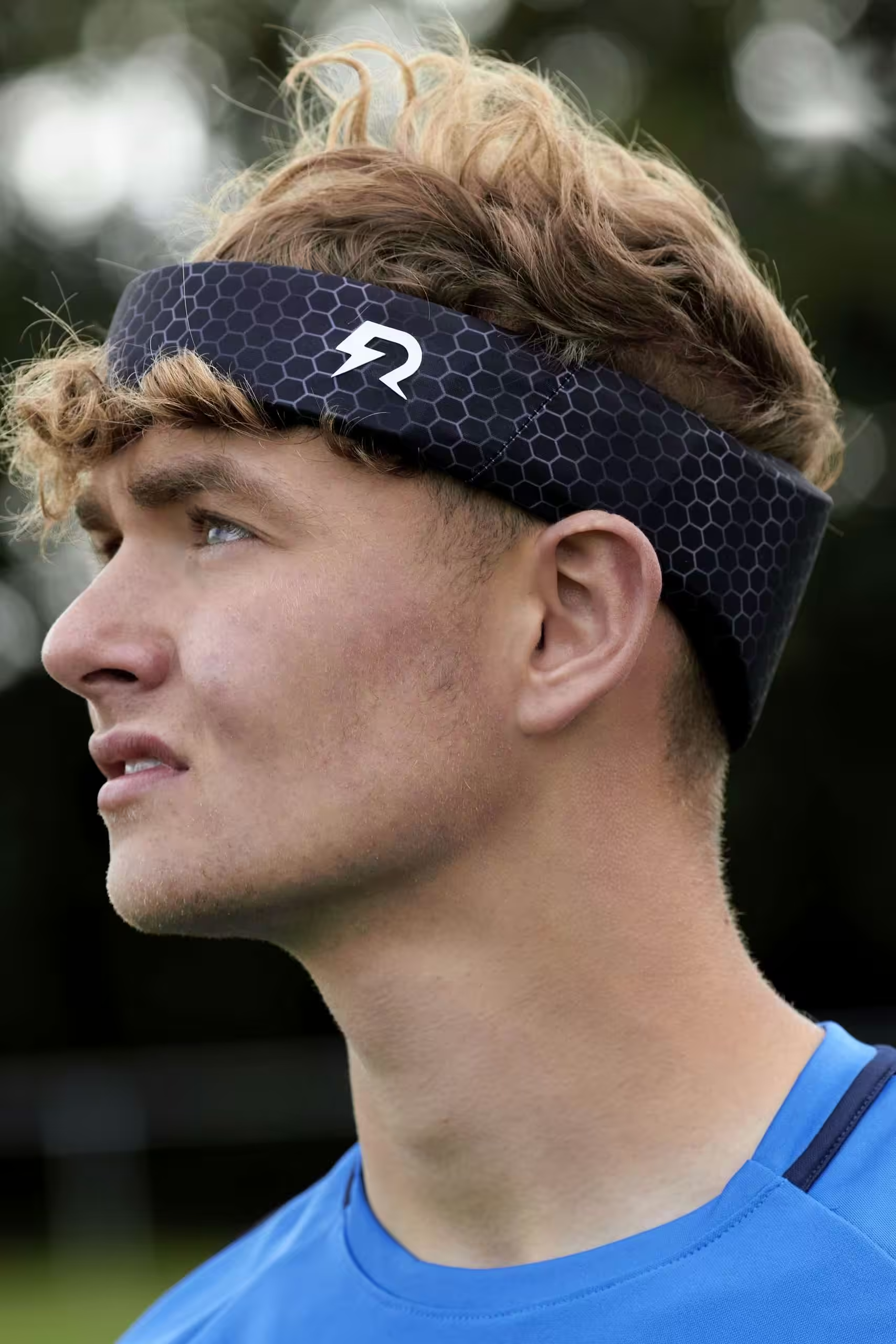
Rezon Halos® instead uses a patented multi-layer kinetic energy dissipation system designed specifically to reduce rotational forces transmitted to the brain.
What should I look for when upgrading my rugby head protection?
If protecting the brain is your priority, look beyond the padding and ‘impact’ reduction claims.
Why parents and players are choosing Rezon Halos®
Rezon Halos® is brain protection for sport.
Its purpose is to reduce the transmission of forces associated with the biomechanics of brain injury in concussive and sub-concussive head impacts, and reduce the accumulated damage from sub-concussions.
Rezon Halos® uses patented Rotection® technology and has been independently tested using Virginia Tech methodology.
Why Choose Halos®:
- reduces rotational force transmission by up to 61%;
- reduces linear force transmission by up to 64%;
- reduces concussion risk by 74%;
- achieved a Virginia Tech 5-Star safety rating;
- holds CE and UKCA Category II PPE certification;
- is the only non-helmeted head-worn protection to combine CE/UKCA Category II PPE certification with a Virginia Tech 5-Star safety rating [7, 8, 9].
This combination matters because the future of sports head protection is not only about padding the outside of the head. It is about protecting the brain by reducing the forces transmitted to the brain and the accumulated damage from sub-concussions.
Frequently Asked Questions
- New generation of headgear for rugby: impact reduction of linear and rotational forces by a viscoelastic material-based rugby head guard. Ganly M, McMahon JM. BMJ Open Sport & Exercise Medicine. 2018.
- Rotational acceleration, brain tissue strain, and the relationship to concussion. Post A, Hoshizaki TB. Journal of Biomechanical Engineering. 2015.
- CTE: The Silent Killer in Contact Sports. MacSweeney E. TEDxAthens. May 2022.
- Leveraging football accelerometer data to quantify associations between repetitive head impacts and chronic traumatic encephalopathy in males. Daneshvar DH, Nair ES, Baucom ZH, Rasch A, Abdolmohammadi B, Uretsky M, Saltiel N, Shah A, Jarnagin J, Baugh CM, Martin BM, Palmisano JN, Cherry JD, Alvarez VE, Huber BR, Weuve J, Nowinski CJ, Cantu RC, Zafonte RD, Dwyer B, Crary JF, Goldstein LE, Kowall NW, Katz DI, Stern RA, Tripodis Y, Stein TD, McClean MD, Alosco ML, McKee AC, Mez J, 2023
- Chronic traumatic encephalopathy (CTE): criteria for neuropathological diagnosis and relationship to repetitive head impacts. Acta Neuropathologica. 2023.
- A laboratory protocol for shoulder-head and head-ground dummy head accelerations during player high-speed rugby tackles. Bradshaw EJ, Conte-Biggar A, Drinkwater EJ, Morris BA, Bruce LM, Hume PA, King DA. PeerJ. 2026.
- Virginia Tech Helmet Lab Ratings | Rezon Halos®
- Rezon Halos® Product Testing.
- Regulation 2016/425 and the Personal Protective Equipment (Enforcement) Regulations 2018: Great Britain. UK Government, Office for Product Safety and Standards.
Author: Alex Reily