Product Testing:
INTERNATIONAL, INDEPENDENT, LEGAL CERTIFICATION
Key Takeaways
- Halos® is the first and only CE Category II PPE-certified protective headband. This is the UK and EU legal standard for protective headwear products, and above any sporting governing body rules.
- Independent testing showed that Halos® reduces linear acceleration in extreme head-to-ground impacts by 41% and, importantly, rotational acceleration by 27%.
- Independent testing showed that Halos® reduces linear acceleration in head-to-head impacts by 64% and, importantly, rotational acceleration by 61%.
- US testing body Virginia Tech rates Halos® five stars, as testing showed it reduces concussion risk by 74%.
- To test product longevity, a Halos® headband used for a season of rugby games and training (receiving c.1500 sub-concussive impacts) was retested to CE certification criteria. It still received full marks – Halos® lasts.
Get your brain in gear
Using internationally-recognised independent testing, Rezon Halos® is the most efficient protective equipment of its type.
Halos® is the first and only CE-approved sports protective of its type, securing Category II PPE certification. It is illegal to sell protective headwear in the UK and Europe without appropriate CE certification.
HEAD-TO-HEAD TESTING
Based on US, independent lab testing at Virginia Polytechnic Institute and State University (Virginia Tech), the Rezon Halos® product:
- Lowers the peak linear acceleration of the head up to 64% on each head-to-head impact; and
- Lowers the peak rotational acceleration of the head up to 61% on each head-to-head impact.
Greater acceleration equals greater force. This means that head impacts subject to greater acceleration produce more linear and rotational forces in the brain.
- Cumulative damage from linear accelerations and rotational accelerations are significantly associated with developing CTE [1].
- Every additional estimated 10,000g cumulative linear acceleration to the head is associated with 20% increased odds of being diagnosed with CTE [1].
- Every additional estimated 1,000,000 rad/s2 cumulative rotational acceleration is associated with 22% increased odds of being diagnosed with CTE [1].
Halos® reduces linear and rotational acceleration, and therefore reduces the transfer of energy to the brain following a head impact. This lessens the potential risk of triggering longer-term neurodegenerative consequences, including CTE. Reducing rotational acceleration is more important because it is rotational forces that cause greater damage to the brain in concussive and sub-concussive impacts.
This testing is significant given the high number of sub-concussions sustained in sports (a player will likely receive thousands over each season and many thousands in a career). Reducing rotational forces from each sub-concussive, head-to-head impact by 61% could lessen longer-term neurodegenerative consequences.
This claim is based on Halos® being tested at Virginia Tech to simulate a head-to-head impact scenario.

The Virginia Tech STAR system is a peer reviewed methodology which allows a biomechanical evaluation of the relative performance of headgear in its ability to reduce the risk of concussion. This is a highly cited methodology that is referenced in several significant peer reviewed articles. In the headgear testing area, this is considered the gold standard.
STAR stands for the Summation of Tests for the Analysis of Risk, and the STAR score is calculated based on a headgear’s performance in a series of impact tests. The impact conditions are sports-specific and inclusive of the broad range of head impacts that athletes are likely to experience. STAR is based on 2 fundamental concepts:
- tests are weighted based on how often people experience similar impacts; and
- headgear that lower linear and rotational head acceleration and reduce injury risk.
The Virginia Tech STAR system uses a bivariate risk function based on over 2 million head impacts that clearly has shown that headgear that better reduces both linear and rotational head kinematics (better STAR ratings) reduces concussion risk in the real world [2].
- Halos® underwent the Soccer Star test methodology. Head-to-head impact tests were conducted on the side and back of the head from across three different velocities (2,3,4 m/s).
- Halos® achieved a five-star rating (0.26 score). This is qualified as reducing the risk of concussion by 74% when wearing Rezon Halos® based on the Virginia Tech methodology.
Below are details of the peak linear and rotational acceleration injury reduction achieved by Halos®. It is based on impacts to the back and side of the head and different velocities.
| Head impact area | Speed (m/s) |
Reduced peak linear acceleration achieved by Halos® | Reduced peak rotational acceleration achieved by Halos® |
|---|---|---|---|
| Back | 2 | 64% | 61% |
| Back | 3 | 50% | 49% |
| Back | 4 | 37% | 36% |
| Side | 2 | 60% | 61% |
| Side | 3 | 49% | 46% |
| Side | 4 | 35% | 40% |
As with any laboratory test, there is a trade-off between repeatability and realism. However, Virginia Tech’s testing is globally recognised as having the best independent data and recognised as the most respected methodology that is publicly available.
EXTREME HEAD-TO-GROUND TESTING
Based on independent lab testing at the internationally renowned Centre of Excellence for Sports Engineering and Research in the UK, the Rezon Halos® product:
- Lowers the peak linear acceleration of the head by an average of 41% on each extreme head-to-ground impact; and
- Lowers peak rotational acceleration of the head by an average of 27% on each extreme head-to-ground impact.
Greater acceleration equals greater force. This means that head impacts subject to greater acceleration produce more linear and rotational forces in the brain.
- Cumulative damage from linear accelerations and rotational accelerations are significantly associated with developing CTE [1].
- Every additional estimated 10,000g cumulative linear acceleration to the head is associated with 20% increased odds of being diagnosed with CTE [1].
- Every additional estimated 1,000,000 rad/s2 cumulative rotational acceleration is associated with 22% increased odds of being diagnosed with CTE [1].
Halos® reduces linear and rotational acceleration, and therefore reduces the transfer of energy to the brain following a head impact, and the likely risk of developing CTE. Reducing rotational acceleration is more important because it is rotational forces that cause greater damage to the brain in concussive and sub-concussive impacts.

This is most significant for the high number of sub-concussions sustained in sports (a player will likely receive thousands over each season and many thousands in a career). Reducing rotational forces from each sub-concussive, head-to-ground impact by 27% could lessen longer-term neurodegenerative consequences.
This testing was to simulate an extreme head-to-ground impact scenario likely in sports.
A freely-suspended headform was held at a consistent orientation prior to being dropped from 98.9cm onto a ridged plane inclined at 45 degrees. The plane was designed to induce the maximum amount of rotational impact possible. It was covered with EVA foam to increase frictional contact forces and initiate a greater rate of rotation.
The inside of the headforms had a triaxial accelerometer and triaxial rate gyro which collected impact data synchronously at 100 kHz and was downloaded after each impact. A high-speed video camera, oriented perpendicular to the plane of impact, captured impact conditions at 2000 frames per second. To establish the base condition, the naked headform was dropped onto the inclined surface. The impact was repeated 9 times for each test condition to allow consistency to be assessed. The headform was then fitted with Halos® with impacts recorded.
| Peak linear acceleration (g) |
Peak rotational acceleration (rad/s2) |
Impact duration (Ms) |
||||
|---|---|---|---|---|---|---|
| Average | Standard Deviation | Average | Standard Deviation | Average | Standard Deviation | |
| Naked Head | 133.7 | 3.4 | 4,798.4 | 241.8 | 14.1 | 0.2 |
| Rezon Halos® | 79.3 | 3.5 | 3,510.2 | 128.8 | 17.4 | 0.2 |

LEGAL CERTIFICATION
All head protection must be tested and certified as Personal Protective Equipment (PPE) Regulation (PPE Directive (EU) 2016/425) before being legally sold in the UK and Europe. PPE legislation is a completely separate piece of legislation from and should not be confused with the Medical Devices Directive.
Head protection beyond cuts and scrapes falls into either Category II (independent testing and certification) or Category III (independent testing and certification, plus ongoing surveillance of production quality). It is illegal to place any protective headwear on the UK and European product market for sale without certification.
For Category II and III products, independent European notified bodies are required to provide certification to show that the manufacturer’s products have complied with the PPE Legislation and that manufacturers may put their CE mark on a product or the UKCA mark in the UK using a UK Approved Body. The independent European notified body/UK approved body will ensure testing covers all of the essential requirements of the PPE legislation. A manufacturer of protective headwear can only place a CE or UKCA mark on the product and/or packaging if the product has been tested and an EU or UK Type Examination Certificate issued by an independent European-notified/UK-approved body.
Halos® is the first and only legally approved protective headwear of its type in the UK and Europe, having secured Category II PPE certification from Italcert Notified body No.0426. It is legally approved to use the CE mark.
Halos® is also UKCA marked, which in accordance with British Government measures, permits a product already covered by a valid EU-type examination certificate.

Rezon Halos® is no longer listed as a Class 1 Medical Device with the MHRA, an executive agency of the Department of Health and Social Care (DHSC) and responsible for the enforcement of medicines and medical device legislation in the United Kingdom. This delisting is at the request of the MHRA, who accept that while Halos® intended purpose in a medical setting is to limit the cumulative effect of the disease CTE or injury that will exacerbate other medical conditions, it does not require a registration with the MHRA as a medical device. This is not related to the efficacy of Halos® or the presented clinical benefits, expert opinions and evidence to the MHRA, but simply to the legal definition of a medical device as adopted by the Borderlines team at the MHRA. The legal definition of a medical device with the MHRA does not indicate that all products providing a “clinical benefit” must be defined as medical devices. This means that products may demonstrate a “clinical benefit” such as Rezon Halos® without them meeting the legal definition of a medical device.
SEASON-LONG DURABILITY
Rezon wanted to find out how Halos® would perform after a season of wearing.
How would the fabrics wear? Would the stitching stay intact? Most importantly, how would the Rotection® technology fare after being used three times a week in training and matches, with regular machine washing to keep Halos® looking and feeling fresh? Would Halos® still offer satisfactory, reliable protection?
To obtain the answers, two samples were submitted to the respected independent test house, SATRA, for testing to the original CE certification criteria. The first sample was a Halos® headband which had been used by a rugby player for a season of matches and training, during which it had received c.1500 sub-concussive impacts and had been washed monthly. The second was a Halos® headband which had been laundered 40 times.
Both samples came through the testing process with full marks. After a season of play and laundering, the first sample retained its ability to reduce impact and reduce concussive and sub-concussive brain injury, with plenty of safety margin remaining. After 40 washes, the second sample was unfaded, demonstrated no shrinkage, no seam breakdown, no detachment of layers, no fraying, no shape distortion, no loss of elasticity, no loss of colourfastness, no loss of silicone gripping, and no fading of the labelling.
These independent tests prove Rezon’s design, choice of materials and manufacturing methods are your guarantee of a robust product that lives up to the claims made.

SETTING THE STANDARD
Rezon is a member of The British Safety Industry Federation. This is the UK Trade Association for the Safety Industry and a major independent voice for UK safety. BSIF work closely with the Health and Safety Executive (HSE) and Trading Standards. BSIF are the lead association for the Personal Protective Equipment (PPE) Regulation.
To help give assurances on PPE and Safety Equipment, BSIF audits members under the ‘Registered Safety Supplier Scheme’. Through this scheme, a strict set of protocols are set for members so they can prove alignment with their regulatory/legislative requirements. The scheme seeks to improve the quality of products and the capability of suppliers in the safety/PPE market. Rezon is a registered safety supplier.


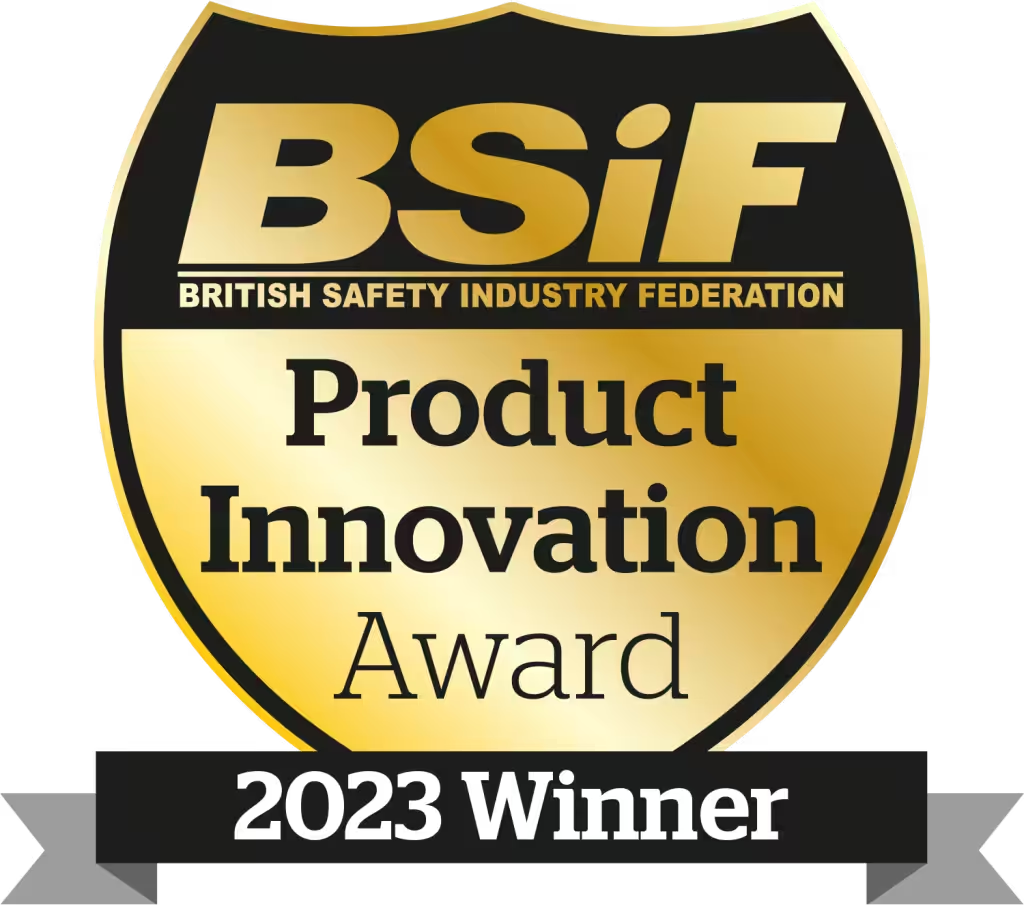
The BSIF (British Safety Institute Federation) Innovation Awards recognises the genius and dedication in presenting equipment that helps to keep users safe today, and in the future.
Rezon Halos® won the British Safety Institute Federation Product Innovation (PPE category) Award 2023 at The Safety & Health Excellence Awards.
- Leveraging football accelerometer data to quantify associations between repetitive head impacts and chronic traumatic encephalopathy in males, Daneshvar DH, Nair ES, Baucom ZH, Rasch A, Abdolmohammadi B, Uretsky M, Saltiel N, Shah A, Jarnagin J, Baugh CM, Martin BM, Palmisano JN, Cherry JD, Alvarez VE, Huber BR, Weuve J, Nowinski CJ, Cantu RC, Zafonte RD, Dwyer B, Crary JF, Goldstein LE, Kowall NW, Katz DI, Stern RA, Tripodis Y, Stein TD, McClean MD, Alosco ML, McKee AC, Mez J, 2023
- Can helmet design reduce the risk of concussion in football? S Rowson, MD Stefan, RM Greenwald, JG Beckwith, JJ Chu, KM Guskiewicz, JP Mihalik, JJ Crisco, BJ Wilcox, TW McAllister, AC Maerlender, SP Broglio, B Schnebel, S Anderson, PG Brolinson, 2014