Technology:
How Rezon’s Brain Protection Technology Works
What technology helps reduce rotational force in sport?
Technology that helps reduce rotational force in sport is designed to protect the brain during concussive and sub-concussive head impacts. Rezon Halos® uses patented Rotection® technology to help reduce rotational force transmission, which matters because rotational motion is strongly associated with brain injury mechanisms such as shear strain and neural tissue damage. Rotational forces cause the brain to rotate inside the skull. This is associated with tearing of tiny blood vessels and brain cells resulting, over time, in the breakdown of the blood-brain barrier and the creation of damaging neuro-inflammation.
Reduce injury, protect the brain
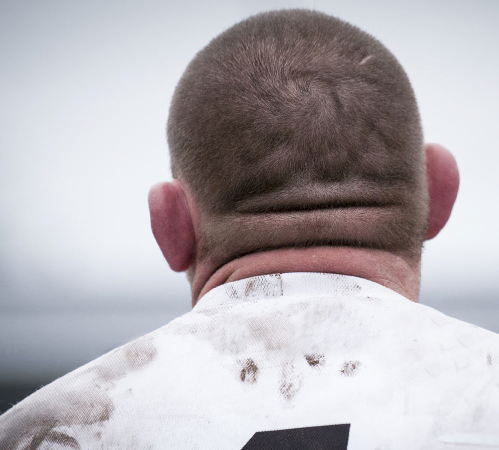
Repetitive, symptomless brain injuries called sub-concussions are causing early-onset dementia (CTE) and neurodegenerative diseases in sports players.
These brain injuries involving rotational forces have not been recognised with the respect they are due. In fact, the brain is generally overlooked in sport, with more focus given to below the neck.
When sports players, such as in rugby, hockey and football, sustain these sub-concussions season after season, it can lead to a build-up of tau protein in the brain. This is the same protein that can cause early-onset dementia. With repetitive trauma, contact and collision sports players are being diagnosed with CTE, a form of early-onset dementia, as early as in their late teenage years.
To protect players of all ages, ability levels, and sports from developing neurodegenerative diseases, we need to reduce the impact of rotational forces to the brain and protect it from sub-concussive brain injuries.
Rotection® technology minimises the transmission of rotational forces to the brain in concussive and sub-concussive impacts.
Rethinking the science
The conventional science used in, and testing of, protective equipment is mostly outdated and irrelevant because it focuses on linear forces and high-force concussion impacts. Rezon’s technology challenges this science.
Reducing Rotational Forces
Rotational forces are the greater risk in sport and more damaging to the brain.
Rotational forces rotate the brain and shear brain cells and fine blood vessels. Linear force (G-force) reduction is less relevant to reducing brain injury, because linear force does less damage to the brain. Linear force reduction is an outdated approach compared to the latest neurological research [1].
Rotational forces experienced during head impacts are important predictors of traumatic brain injury risk [2] and the increased risk of developing CTE [3].
Reducing Sub-Concussions
Sub-concussions are the greater risk in sport and more damaging to the brain because they are a silent injury, unnoticed, untreated, and players aren’t protected against them.
While reducing the frequency of concussion in sport is important, sub-concussions are 500 times more frequent, and the force needed to cause one is 2-4 times less. They are symptomless, meaning players aren’t given time to recover or even aware they need to recover. They are caused by rotational head injuries from, for example, head to head, ground, knee or ball impacts.
Rezon does not solely focus on concussion because it is sub-concussions that are more frequent in sport.
Rezon works with leading global experts who understand the science and danger of these brain injuries and the physicality of the brain. Together we have developed the world’s most advanced solution to reducing rotational brain injury from concussive and sub-concussive impacts.
Rotection® Technology
Rotection® technology is made up of nine independent protective layers that reduce dangerous rotational forces to the brain. When the layers move over each other, they reduce the transmission (or passing through) of rotational forces. Linear forces are also reduced.
Rotational forces from a head impact cause damage to the brain at three points:
- the point of impact;
- the opposite side of the brain; and
- when the brain comes to a final stop and rotates.
Rotection® technology reduces the transmission of rotational forces to the brain to lessen the tearing of brain cells and blood vessels, brain inflammation, and lower the cumulative exposure of rotational forces to the brain.
How Rotection® technology reduces rotational forces to the brain.
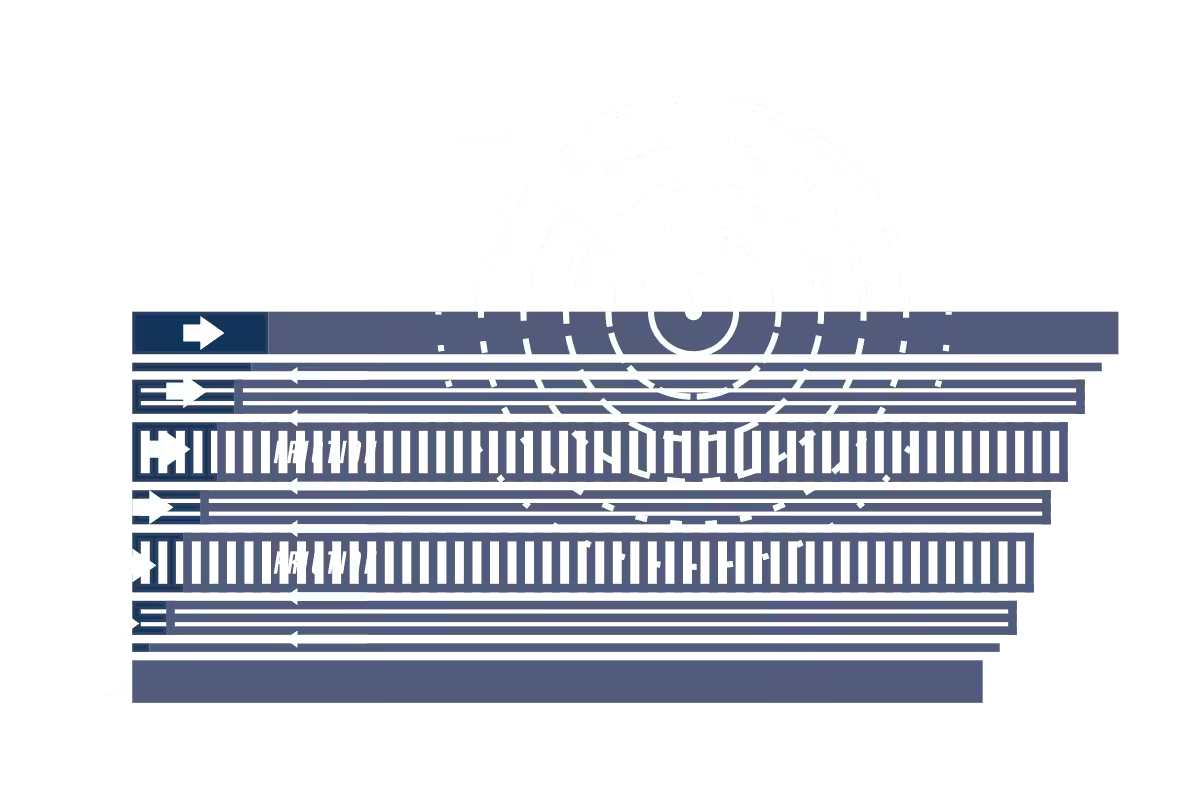
On impact, the nine layers move over each other. When the layers move over each other they reduce the transmission, or passing through, of rotational forces to the brain. Linear forces are also reduced.
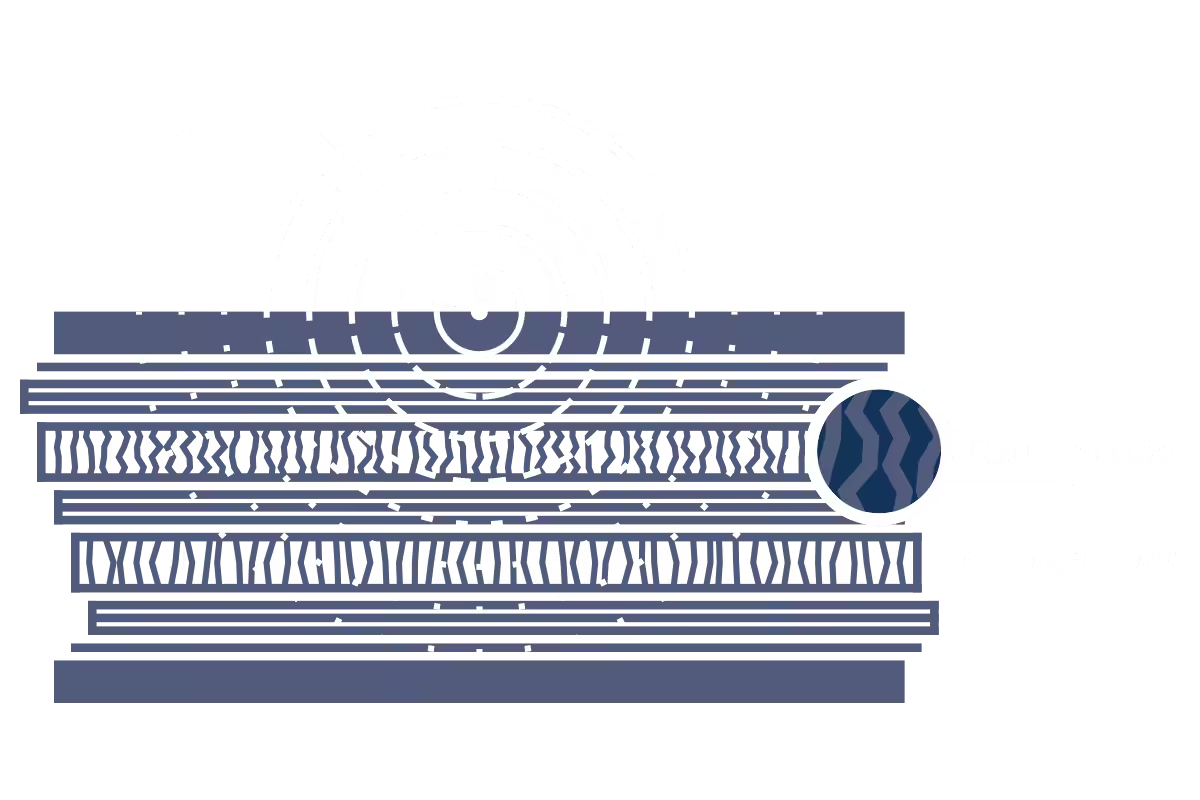
Additionally, three specific layers deform to further reduce impact energy.
Rotection® is patented. UK Patent Serial Number: GB2604408. International patent application no. PCT/GB2022/051356.
Rotection® technology is proven to reduce the transmission of rotational forces by up to 61%, based on testing at the world’s leading independent test lab with a globally accepted methodology to evaluate the performance of headgear to reduce the probability risk of concussion.
Mainstream headwear doesn’t protect the brain
Head-worn protection in sport is typically considered in the form of helmets or headguards (scrum caps) in rugby.
Helmets are designed to protect the skull, not the brain. While a helmet effectively protects the skull from fractures, the brain instead receives the full force of the impact, resulting in concussion and sub-concussions.
Helmets are mostly tested against linear force reduction, not rotational forces. Ironically, helmets increase brain trauma by permitting more and heavier impacts to the brain.
Headguards (scrum caps) are not protective to the skull or the brain. They are only intended to protect against cuts and abrasions. World Rugby have designed the approval standard for headgear in a way that limits the full protection of players from brain trauma. Players are encouraged to protect themselves, rather than with safety equipment.
Headguards compliant with World Rugby regulation are not intended nor expected to protect against any form of concussion, sub-concussions, or skull fractures. This explains why multiple studies [4] have illustrated that conventional headgear offers no statistically significant prevention or protection against concussion. Yet most players (82%), coaches (66%) and referees (64%) incorrectly believe protective equipment prevents concussion in rugby [5]. More concerningly, around a third of both club and school rugby players incorrectly believe that wearing a scrum cap/ headguard can prevent a player from getting CTE [6].
The design of a headguard (scrum cap) increases the risk of rotational forces to the brain. The gaps between the foam shapes create an uneven surface that allows for more rotational “catch points”, meaning more linear forces become rotational. Also, with a scrum cap design it closes or ties in the posterior portion of the head, meaning player vulnerability to impacts received to the back of the head and the occipital region of the brain.
Scrum caps have remained unchanged in their shape and design for over 100 years, before this neurological science was understood. The scrum cap design is fundamentally flawed in its inability to protect the brain from rotational injury. This is why Rezon would not use Rotection® technology in a headguard (scrum cap).

World Rugby Law 4 Headgear Trial
World Rugby has developed a trial process to enable the assessment of rugby headgear which, ‘according to the manufacturers have been designed to achieve specific, quantifiable medical purposes’ [7]. This specification uses World Rugby Regulation 12 (that headgear is not intended nor expected to protect against any form of mild traumatic brain injury or skull fractures) as a base specification with variations which do not increase the onerousness of the tests, or the requirements from Regulation 12. Given the position of the MHRA and EU Commission under the Borderline Manual [8], a rugby helmet cannot be considered as having ‘medical purposes’.
How do we compare?
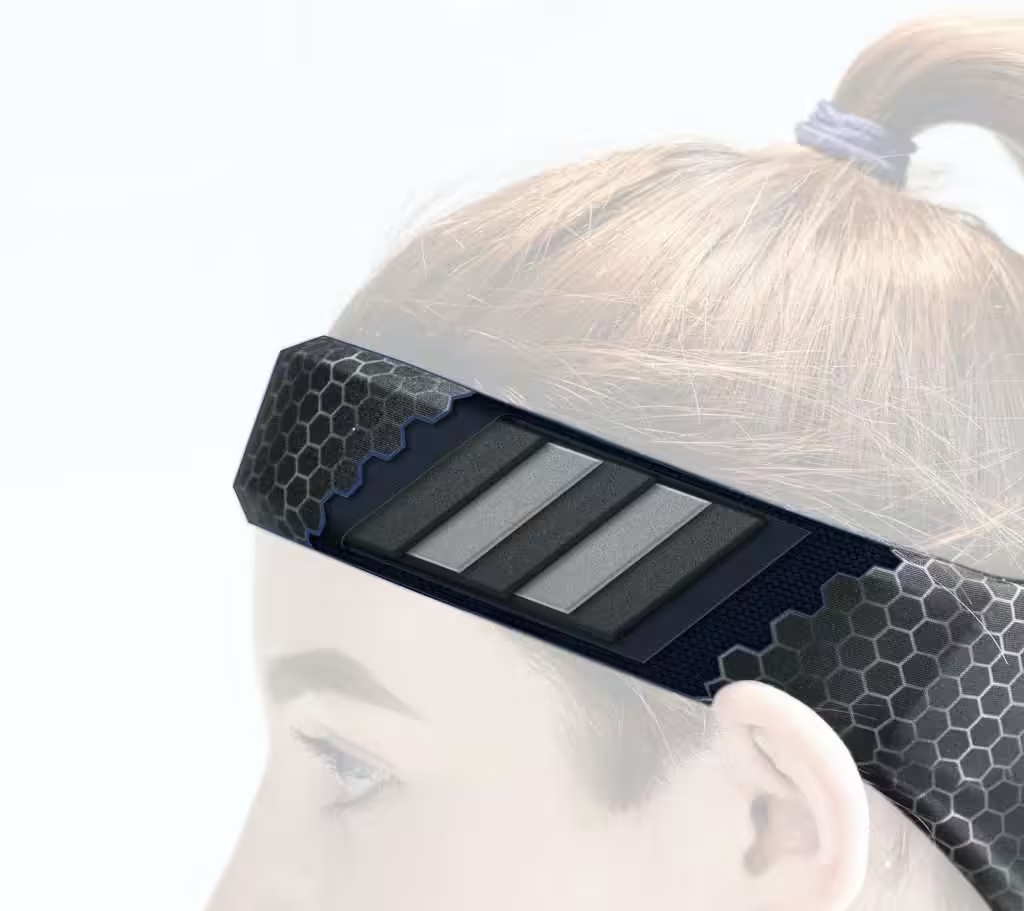
Rezon has incorporated Rotection® technology into a soft-form, protective sports headband, Halos®.
Halos® is in a league of its own for brain protection, design and legality. Rezon Halos® is differentiated by published rotational force reduction, CE/UKCA Category II PPE certification, and patented Rotection® technology.
| Product (Technology) | Brain Protection | Qualified Rotational Force Reduction* | PPE CE** | Medical Device Registered*** | Sport(s) | Product Weight | Product Thickness |
|---|---|---|---|---|---|---|---|
| Rezon Halos® (Rotection) | Yes | Yes: Allows 30mm slippage & 61% rotational force reduction | Yes – Category II | No**** | Multi-sport (contact and collision sports) | 70 grams | 9.5mm |
| N-Pro Scrum Cap (Defentex) |
No | Yes: an average of 34% | Yes – Category II | No | Rugby | 190 grams | 13mm |
| Hedkayse Headguard R5 (Enkayse) | No | No | Yes – Category I | No | Rugby | 220 grams | 11mm |
| Unequal Halo 1 & 2 (Acceleron) | No | No | No | No | Football | 178 grams | 10mm |
| HeadStrong Headguard (IMPALT silicone gel) | No | No | No | No | Football | 190 grams | 8-17-26mm |
| Storelli Exoshield (Zorbium) | No | No | No | No | Football | 116 grams | 12mm |
| Gamebreaker Aura (D30) | No | No | No | No | Sport Agnostic | 86 grams | 10mm |
| MIPS (Multi-directional Impact Protection System) | Yes | Yes: Allows 15mm slippage | No | No | Helmeted Sports | A liner material within specific helmeted products | A liner material within specific helmeted products |
* As described on brand website and marketing materials.
** Head protection, beyond cuts and scrapes, falls into either Category II or Category III Personal Protective Equipment (PPE) certification. It is illegal to place any protective headwear on the UK and European product market for sale without PPE certification.
*** Manufacturers have a duty not to imply compliance, performance or intended use in any of the geographical markets where the packaging is used, if the market requirements are not met.
**** The legal definition of a medical device with the MHRA does not indicate that all products providing a “clinical benefit” must be defined as medical devices.
Halos® is compared against leading competitor products (as described on their website/product information):
N-Pro, a rugby scrum cap/headguard designed to reduce the linear/ g-force energy transferred to a player’s head during impact. World Rugby have devised a new five-year Global Law Trial for headgear designed to help reduce head injury risk, but this only requires linear acceleration testing to be carried out. N-Pro is the only headguard to be approved for this trial. Irish product.
Hedkayse, a rugby scrum cap/headguard designed to reduce the linear/ g-force energy transferred to a player’s head during impact. British product.
Unequal Halo 1 and 2, a football (soccer) headband that absorbs and disperses impact shock and reduces acceleration. No detail given on rotational force reduction, with greater focus and explanation on linear force reduction. US product.
Headstrong, a headguard focused on being able to head the ball in football given current calls to reduce and ban heading. The band has no protection on the forehead, and has a liquid gel core at back and sides to better absorb and divert the energy of impact to the head. No detail given on rotational force reduction, with greater focus and explanation on linear force reduction. Danish product.
Storelli, a football (soccer) headguard made from foam that is engineered specially for soccer to reduce g-forces to the head by up to 50%. No detail given on rotational force reduction, with greater focus and explanation on linear force reduction. US product.
Gamebreaker, a football (soccer) headband that can also be used in other sports. No detail given on rotational force reduction, with greater focus and explanation on linear force reduction through D3O® impact protection material. US product.
Mips, a liner material used in 120+ helmet brands that allows a multi-directional movement of 10-15mm on certain angled head impacts to help reduce rotational forces. Swedish product.
Rethought design
With Halos®, every design principle and decision is intentional to create the world’s most advanced and technically superior solution to reducing brain injury.
Ergonomic shaping:
Halos® covers those areas of the head with the highest probability of incurring head injuries in sport – importantly, where 80% of all impacts occur. Halos® provides 53% adult male head coverage.
The shape of the Halos® is deliberately engineered to avoid generating false confidence in the wearer, known as the risk compensation theory. The risk compensation theory is that players may be at greater risk of sustaining injuries due to increased risk-taking and an increase in aggressive play because they assume a greater safety when wearing headgear.
Currently the research regarding risk compensation is mixed and also sport/physical activity specific. In sports where concussion mitigation has become a major issue, such as Australian Rules football and football (soccer), the wearing of headgear has not appeared to have changed players’ behaviours [9] [10].
Halos® also minimises any negative impact on the performance and playing technique of the wearer, including the power and direction of heading a football.
Game comfort:
Halos® outer layer is a smooth, sleek, high-grade performance fabric that is water-repellent, tear-resistant, and repels UV rays. The smooth, skin-like exterior is a deliberate design feature to avoid any creation of rotational force “catch points”.
Next to the head, an anti-odour, anti-microbial and hypoallergenic lining provides comfort. In addition, a textured silicone grip layer keeps Halos® securely in place during play, including the heading of a football, or in the scrum and ruck in rugby. The silicone grips also create air channels that facilitate skin cooling, breathability and sweat-wicking.
Smart as it is simple
At 9.5mm thickness and 70 grams, Halos® is the world’s lightest and thinnest Virginia Tech 5-star rated protective, CE-approved, sports headband. Virginia Tech provides ratings that allow consumers to make informed decisions when purchasing helmets and protective headgear on products that lower head acceleration and reduce concussion risk. The ratings and test results are based on more than 10 years of research on head impacts in sports based on over 2 million head impacts and off-field data, and are independent of any influence from manufacturers.

- Why Most Traumatic Brain Injuries are Not Caused by Linear Acceleration but Skull Fractures are, Kleiven S. 2013
- The mechanics of traumatic brain injury: a review of what we know and what we need to know for reducing its societal burden, Meaney et al, 2014.
- Cavum Septum Pellucidum in Former American Football Players, Findings From the DIAGNOSE CTE research project, Arciniega H,Jung LB, Tuz-ZahraF,etal. Neurol Clin Pract. 2024
- Rugby headgear and concussion prevention: misconceptions could increase aggressive play, Menger R, Menger A, & Nanda A, 2016.
- Concussed or Not? An Assessment of Concussion Experience and Knowledge Within Elite and Semiprofessional Rugby Union, Mathema P, Evans D, Moore IS, Ranson C, Martin R, 2016.
- Knowledge and attitudes of concussion and chronic traumatic encephalopathy amongst a sample of non-professional rugby players, Moore J & Deasy C, 2025
- World Rugby Law 4 Headgear Trial, World Rugby.
- Manual on Borderline and Classification in the Community Regulatory Framework for Medical Devices, 2019.
- The association of padded headgear with concussion and injury risk in junior Australian football: A prospective cohort study, JM Knight, B Mitra, A McIntosh, TS Howard, P Clifton, M Makdissi, JV Rosenfeld, P Harcourt, C Willmott, 2022
- Does soccer headgear reduce the incidence of sport-related concussion? A cluster, randomised controlled trial of adolescent athletes, McGuine T, Post E, Pfaller AY, et al, 2020