Rezon Survey


What Does the Rezon Survey Reveal About Brain Injury Risk in Sport?
The Rezon Survey 2025, conducted in partnership with the UK National Innovation Centre for Ageing (NICA) and Voice®, found a gap between perceived understanding of concussion and the scientific mechanisms that drive cumulative brain injury risk in sport.
The survey found that:
- Respondents had high confidence in recognising concussion, but low understanding of sub-concussions.
- Participants didn’t understand the connection between sub-concussion and developing CTE.
- Respondents incorrectly believed that children are at lower risk of brain injury.
- People don’t understand what brain protection is.
Concussion Is Understood; Sub-Concussion Is Not
The survey shows that concussion awareness campaigns are effective. Most respondents could identify common concussion symptoms and signs, and understood the importance of removal from play for a concussed player.
However, the same respondents showed a limited understanding of sub-concussions. Sub-concussions are small-force head impacts that cause no visible concussion signs or symptoms of concussion, yet still cause damage to the brain. These impacts occur far more frequently than concussions (hundreds of times more) and their damage accumulates over time.
This distinction is clinically important. While an individual sub-concussion is asymptomatic; multiple sub-concussions can adversely affect memory, the ability to focus, learn and think as well as behaviour. Repetitive sub-concussive impacts are now understood to be a primary driver of long-term brain injury risk, including neurodegenerative diseases such as CTE [1].
Awareness of the Cause of CTE is Poor
Only a small proportion of respondents recognised that sub-concussive impacts are most strongly associated with developing Chronic Traumatic Encephalopathy (CTE). This reflects a widespread public and media misconception that CTE develops from concussion(s).
In reality, CTE develops through cumulative exposure to repetitive sub-concussive head impacts, most often beginning in childhood and with symptoms emerging decade(s) later. These small-force, sub-concussive impacts generate rotational forces within the brain that produce shear strain in neural tissue, disrupt the blood–brain barrier, and trigger damaging neuro-inflammation over time.
This inflammatory response is increasingly understood as a key pathway through which repeated head impacts may initiate long-term neurodegenerative processes [2].
World-leading neuroradiologist Dr Emer MacSweeney has highlighted this cumulative mechanism of injury in sport in her TEDx Talk on CTE, noting that repeated symptomless impacts may represent a greater long-term risk to brain health than isolated concussive events. Watch Dr Emer MacSweeney’s TED Talk on CTE and brain injury in sport.
An incorrect perception of brain injury risk in children exists
One of the most striking survey findings is that children were ranked as being at lower risk of brain injury in sport than adult players. This belief is incorrect.
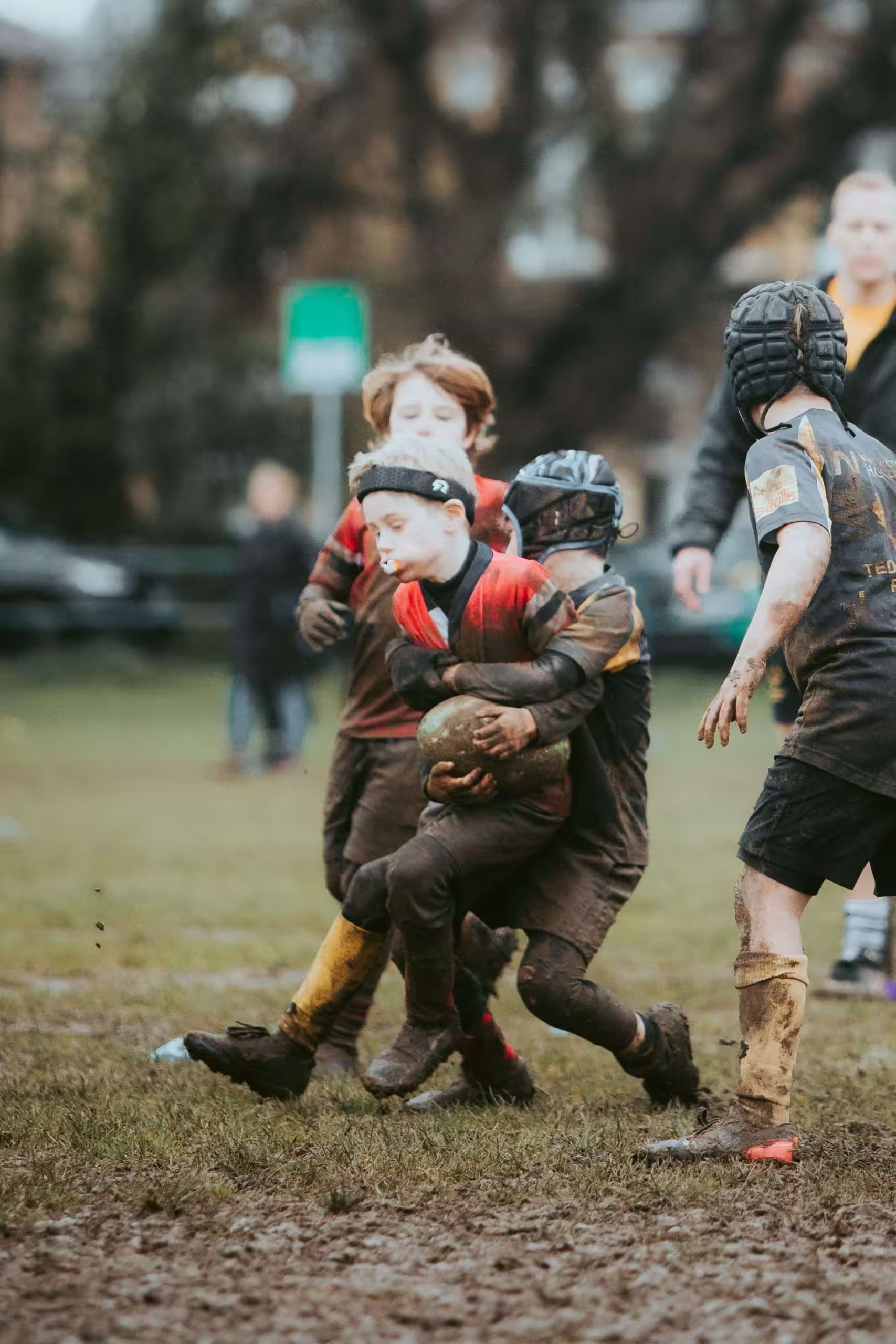
Research shows that a child’s brain is more susceptible and they have a longer lifetime exposure window to concussion and sub-concussions. Brain injury risk does not begin at elite or professional level; it begins with youth exposure from concussive and sub-concussive head impacts during school and club sport.
What is unknown is which child may have a genetic or metabolic vulnerability, or which child will go on to play sport into adulthood. Therefore, given the damage of sub-concussions are cumulative, children may be exposed to a cumulative lifetime burden of head impacts, and bluntly their CTE and risk of neuro-degenerative disease does start in childhood.
A misunderstanding of Head Protection vs Brain Protection
The survey revealed confusion not about what traditional and conventional head protection does, but about whether better options exist.
Most traditional head protection used in sport, including scrum caps and padded headgear, is designed and limited to reduce surface injuries such as cuts, abrasions and lacerations. These products were never intended, designed or tested to protect the brain from injury.
Many respondents appeared unaware that brain injury is driven primarily by rotational forces to the brain. These cause the brain to rotate inside the skull. This is associated with tearing of tiny blood vessels and brain cells, resulting, over time, in the breakdown of the blood-brain barrier and the creation of damaging neuro-inflammation.
Respondents were unaware that protective equipment can be specifically engineered to reduce rotational forces. This design and purpose distinction of protective headgear really matters. Protecting the head from surface injury is not the same as protecting the brain from rotational forces and reducing brain injury.
Brain Protection in sport
The use of head protection in sport is widely debated, and misunderstood. Parents, players and coaches believe they understand the risks of head injury in sport, yet new data shows there are critical gaps between perception and reality; gaps that matter for long-term brain health.


The Rezon Survey, developed in partnership with the UK National Innovation Centre for Ageing and Voice at Newcastle University, set out to determine what people involved in sport actually know about brain injury, sub-concussions and protective equipment. Its findings reveal a consistent but concerning pattern: awareness of concussion is high, but an understanding of mechanisms of brain injury and how neuro-degenerative disease really develops is low.
Gaps in Understanding Explained by the Science
The Rezon Survey highlights critical education gaps around the mechanics of brain injury and the biomechanics of the brain. Neuroscience already tells us that:
- Rotational forces pose a greater risk to brain tissue than linear (straight-line) forces
- Every head impact involves rotational acceleration and forces
- Head impacts do not need to cause signs or symptoms to cause brain damage
- Detection and management of concussion alone do not address cumulative brain injury or reduce the risk of developing neurodegenerative consequences [3].

Redefining Headworn Protection in Sport
If headworn protection is to meaningfully reduce brain injury risk, it must:
- Reduce rotational forces transmitted to the brain
- Protect in concussive impacts and reduce the cumulative damage from sub-concussive impacts
- Function across impact sports (contact, collision and combat) during training as well as games and competition
- Be useable from early years to reduce every child’s risk of lifetime exposure
- Be independently tested using biomechanical evidence to inform clinical validation, and legally compliant with domestic and international safety laws and standards.
This represents a shift in design and function from reactive injury management to proactive and leading-edge brain protection.

From Head Protection to Brain Protection
The findings of the Rezon Survey explain why new approaches to brain protection and enhanced education around brain protection are required. Rezon Halos® was developed to address the mechanisms of brain injury that traditional and conventional headgear does not.
Halos® is designed specifically to reduce rotational force transmission to the brain, to reduce the risk of concussion and protection against the cumulative damage of sub-concussions. It is independently tested, CE / UKCA Category II PPE certified, and Virginia Tech 5-star safety rated, the only product globally to have this status [4].
What is the Rezon Survey?
The Rezon Survey asked parents, players and coaches about:
- Their understanding of concussion and sub-concussion
- Perceived brain injury risk in sport across ages and genders
- What they believe head protection in sport is designed to protect
- Awareness of long-term neurological risks from head impacts such as Chronic Traumatic Encephalopathy (CTE), a progressive neurodegenerative disease that leads to early-onset dementia.
The survey was designed to reflect real-world decision-making in grassroots and youth sport; and the choices parents, coaches and players make every week.
Internet of Caring Things® (IoCT™) is a programme developed by the UK National Innovation Centre for Ageing (NICA), jointly funded by the North of Tyne Combined Authority and Newcastle University, backed up by the technical support of the Centre for Process and Innovation (CPI).
Survey Methodology and Sample
The Rezon Survey was developed by Rezon in partnership with the UK National Innovation Centre for Ageing (NICA) and Voice at Newcastle University to assess real-world understanding of brain injury risk, sub-concussion, and head protection in sport.
The survey targeted individuals directly involved in grassroots and youth sport decision-making, including parents, players, and coaches. Questions were designed to test both perceived confidence and actual understanding of key concepts, including concussion, sub-concussion, long-term neurological risk, and the purpose of protective headwear.
Responses were independently analysed to identify gaps between awareness and evidence-based neuroscience, with a particular focus on age-related risk perception, gender differences, and misconceptions around head versus brain protection.
The findings presented on this page reflect aggregated survey responses and are intended to inform education, policy discussion, and evidence-based approaches to brain protection in sport.
- What are sub-concussions? Further Reading. Rezon.
- What a world-leading neuroradiologist wants you to know about CTE. Re:Cognition Health.
- Brain injury in football. Further Reading. Rezon.
- Brain injury science. Further Reading. Rezon.