The impacts we ignore may be the ones sport most needs to understand
For many years, sport has focused on the obvious concussive event: the collision that stops the game, the player who looks dazed, the child who reports symptoms, the incident that triggers concern.
That focus is understandable. But it is not enough.
Repetitive head impacts are repeated blows to the head or body that transmit force to the brain. These are typically sub-concussive, meaning they do not meet the criteria for a diagnosed concussion or mild traumatic brain injury. The problem is that this makes them easy to dismiss. If the child gets up, carries on and shows no obvious signs, the impact is often treated as though it did not matter.
That assumption is increasingly difficult to defend.
Sub-concussive head impacts may occur up to 500 times more often than diagnosed concussions. That frequency changes the whole brain safety conversation. The potential cumulative load from repeated sub-concussive exposure is far greater than the load from a single diagnosed concussion, particularly across a season, a childhood or a playing career [1].
This is the point sport, parents, schools and coaches have been slow to confront. The absence of concussion symptoms is not the same as the absence of force. The absence of diagnosis is not the same as the absence of brain stress. A concussion is the visible symptom of brain injury, but brain stress is not limited to impacts severe enough to produce a concussion diagnosis.
If we only count the concussive impacts that stop play, we are not really counting brain risk at all.
What the new 2026 brain imaging study found
The new Brain Communications study examined 165 male former American football players and 52 unexposed asymptomatic controls as part of the DIAGNOSE CTE Research Project. Researchers used diffusion MRI to assess white matter microstructure and examined how exposure history related to brain imaging measures [2].
White matter is central to how different parts of the brain communicate. It contains the connections that help transmit information across brain networks. In this study, researchers looked at diffusion MRI measures, including fractional anisotropy and tissue-corrected fractional anisotropy. These are imaging measures used to assess aspects of white matter microstructure [2].
Among former football players, earlier age of first exposure to tackle football was associated with lower fractional anisotropy and tissue-corrected fractional anisotropy. Lower tissue-corrected fractional anisotropy was also associated with greater estimated cumulative head impact burden, with significant reductions observed in both estimated linear acceleration and rotational force exposure [2].
The significance of this study is not that it gives sport a simple one-impact, one-injury answer. It does not.
Its importance is that it adds to the evidence that sub-concussive exposure history matters. When sub-concussive head impacts begin matters. How often they happen matters. The rotational forces transmitted to the brain matter.
That is especially important when we talk about children.
Why the youth evidence should concern every contact sport
The brain injury risk in sport is often seen through the lens of retired athletes looking back over a long career. But doing so neglects to consider when the damage occurred. Brain injury doesn’t wait until a player is representing their country on an international field; it begins whenever the first repeated sub-concussive head impacts in sport begin for that player.
A 2016 Radiology study examined boys aged 8 to 13 over a single season of youth football. The study looked at whether sub-concussive impacts from one season were associated with changes in specific white matter tracts using diffusion-tensor imaging, in children who had no clinically diagnosed concussions [3].
That is the key point. These were not children being studied because they had suffered diagnosed concussion. They were children exposed to the repeated head impacts that do occur in normal play.
The study reported measurable brain imaging changes after one season of youth football without diagnosed concussion. Reporting from the Radiological Society of North America described the findings as measurable brain changes in children after a single season of play, even without concussion diagnosis [3].
That does not mean every child who plays contact sport will suffer lasting harm. It does mean youth sport should stop treating repeated head impacts as routine simply because they do not produce visible symptoms.
Children are not small adults. Their brains are still developing structurally and functionally. The age at which exposure begins, the number of sub-concussive head impacts experienced and the type of force transmitted to the brain all deserve much more serious attention.
Sub-concussions are invisible; that does not mean they are harmless
The language of “sub-concussion” may be part of the problem. It sounds less important.
But sub-concussive does not mean harmless. It means the impact did not meet the threshold for a concussion diagnosis. It says very little about the mechanical force of the impact or the cumulative load being placed on the brain over time.
A 2024 British Journal of Sports Medicine article argues that “subconcussive” is a dangerous misnomer because some hits of greater magnitude than concussive impacts may not cause symptoms. The authors suggest that the more accurate term would be “non-concussive head acceleration event” because the issue is not whether the impact was biologically insignificant. The issue is whether it produced signs or symptoms that led to a concussion diagnosis [4].
Sport hears “sub” and thinks “less serious.” That is the mistake. The real distinction is not necessarily force. It is visibility.
A child can absorb a significant head acceleration event and still keep playing. A player can experience repeated loading to the brain without a moment that looks dramatic from the sidelines. A season can contain hundreds or thousands of sub-concussive impacts that are individually ignored but collectively meaningful.
This is why the term needs challenging. We may continue to use “sub-concussion” because it is familiar and widely searched. But we should not allow the word to minimise the issue.
These impacts are invisible. That does not make them harmless.
“Rezon Halos® reduces the cumulative dose of sub-concussive impacts to the brain in contact sports. Sub-concussive impacts are the primary cause of Chronic Traumatic Encephalopathy (CTE), today’s most feared complication of rugby, football and other contact sports.”
Dr Emer MacSweeney, Consultant Neuroradiologist and co-founder of Re:Cognition Health, is part of Rezon’s expert team.

This is further Evidence of what brain experts have warned for years
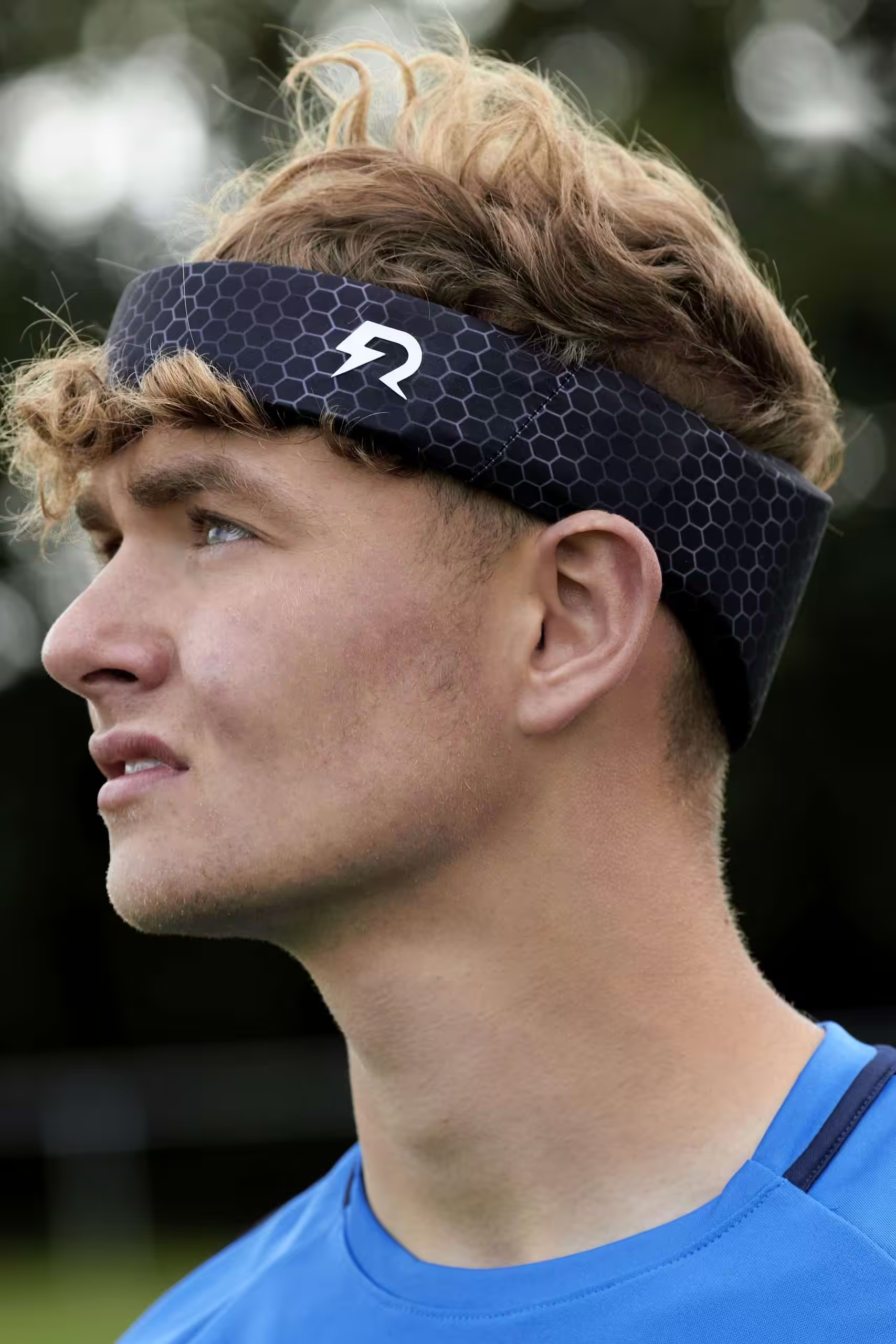
Rezon Halos® was designed with the understanding that sub-concussive exposure and rotational forces matter.
That was a deliberate scientific and protective position. The brain is not only at risk when there are visible symptoms of concussion. It is also exposed to repeated forces that can accumulate over time. That is why Rezon’s focus has always been brain protection and the reduction of rotational force transmission in concussive and sub-concussive head impacts, not generic head protection.
In 2022, Dr Emer MacSweeney used her TEDxAthens talk, “CTE: The Silent Killer in Contact Sports,” to warn about the hidden danger of repetitive head injuries in contact sport, and explained how Rezon Halos® can help to mitigate risk [5].
Rezon has been supported by leading brain experts from the outset because our work has focused on a simple but under-addressed question: how do we reduce the rotational forces transmitted to the brain in the first place?
This new 2026 study is another point of evidence. It strengthens the case that the age, repetition and biomechanical force of head impacts deserve serious attention.
It also reinforces something sport must now accept. This debate cannot remain limited to the impacts everyone can see.
The future of sport is safer participation
This is not an argument against children playing sport. On the contrary, Rezon is pro-sport and always has been.
It is an argument for sport becoming more serious about brain protection. Rezon Halos® offers a pragmatic option to protect the brain in sport without changing the game.
The future should not be framed as participation or protection. That is a false choice. The goal is safer participation: better education, smarter rules, reduced unnecessary head contact in training, greater awareness of cumulative load, and protective equipment designed around the forces most relevant to the brain.
The evidence is moving in a clear direction. Repeated head impacts matter. Sub-concussive exposure should not be dismissed. Rotational force must be part of the conversation. Children’s brains deserve protection before symptoms appear.
We should not need a child to be visibly concussed before we decide their brain is worth protecting.
If we want children to benefit from sport for life, we must take repetitive head impacts seriously to protect their most valuable asset, their brain.
Rezon Halos® Is Brain Protection For Sport
Its purpose is to reduce the transmission of forces associated with the biomechanics of brain injury in concussive and sub-concussive head impacts.
Rezon Halos® uses patented Rotection® technology and has been independently tested using Virginia Tech methodology.
Why Choose Halos®:
- reduces rotational force transmission by up to 61%;
- reduces linear force transmission by up to 64%;
- reduces concussion risk by 74%;
- achieved a Virginia Tech 5-Star safety rating;
- holds CE and UKCA Category II PPE certification;
- is the only non-helmeted head-worn protection to combine CE/UKCA Category II PPE certification with a Virginia Tech 5-Star safety rating [6].
This combination matters because the future of sports head protection is not only about padding the outside of the head. It is about reducing the forces transmitted to the brain.
- Leveraging football accelerometer data to quantify associations between repetitive head impacts and chronic traumatic encephalopathy in males. Daneshvar DH, Nair ES, Baucom ZH, et al. Nature Communications. 2023.
- Dose-dependent white matter changes associated with repetitive head impacts in former American football players. Brain Communications. 2026.
- Subconcussive Head Impact Exposure and White Matter Tract Changes over a Single Season of Youth Football. Bahrami N, Sharma D, Rosenthal S, et al. Radiology. 2016
- ‘Subconcussive’ is a dangerous misnomer: hits of greater magnitude than concussive impacts may not cause symptoms. Nowinski CJ, Rhim HC, McKee AC, Zafonte RD, Dodick DW, Cantu RC, Daneshvar DH. British Journal of Sports Medicine. 2024.
- CTE: The Silent Killer in Contact Sports. TEDxAthens. May 2022.
- Soccer Headgear Ratings. Virginia Tech Helmet Lab.
Author: Judith McMinn