Is flag football safe?
Flag football is deemed safer than American football, or tackle football, but it is not risk-free. Research in youth players found a median of 8 head impacts per season in flag football compared with 378 in tackle football. But accidental collisions, falls and head-to-ground contact can still cause concussions and sub-concussions in flag football players [1].
Flag football has removed a major source of head impacts by removing tackling. The next step in player safety is understanding the brain injury risk that remains and reducing avoidable rotational force transmission and sub-concussions when head impacts do occur.
Flag football is worth protecting, but flag football players matter more
Flag football keeps many of the elements that make American football compelling: speed, skill, strategy, teamwork and competition, while removing deliberate tackling. Its growth is taking the sport onto the world’s biggest stage. Flag football will make its Olympic debut at the Los Angeles 2028 Games, with men’s and women’s competitions [2]. That is good news for sport. But as flag football grows in popularity, the way its safety is discussed matters too.
Flag football is frequently described as a non-contact sport. That describes the rules: defenders stop the ball carrier by removing a flag rather than tackling them to the ground. It does not mean physical contact and head impacts never occur.
Players still sprint at speed, jump for passes, change direction, compete for space, fall and collide with one another. And flag football is not unusual in this respect.
Sports commonly described as non-contact or limited-contact still record head injuries and concussions, and players are still exposed to repeated sub-concussions. In collegiate field hockey, concussion was the most commonly reported specific injury in NCAA surveillance between 2014–15 and 2018–19, accounting for 8.6% of recorded injuries [3]. In NCAA basketball, concussion rates were recorded at 0.38 per 1,000 athlete-exposures in men and 0.53 in women during surveillance from 2011–12 through 2014–15 [4]. And a 2025 prospective study following 90 elite UK netball players recorded six player-contact concussion injuries during one season: two during matches and four during training [5].
Removing intentional contact does not remove all head-impact and brain-injury risk. Flag football removes tackling. It does not remove accidental collisions, falls, or change the biomechanics of what happens to the brain when a head impact does inevitably occur.
Can you get a concussion in flag football?
Yes. A player can sustain a concussion in flag football even though tackling is prohibited.
In flag football, concussions can happen because of:
- player-to-player collisions;
- accidental head-to-head contact;
- a player falling and striking the ground;
- contact with another player’s shoulder, hip, elbow or knee;
- two players colliding while competing for a pass;
- an unexpected impact while running or changing direction at speed.
Recent injury research reinforces this. A 2025 study examining US emergency-department-treated flag football injuries from 2013 to 2022 found that player-to-player collision was the most common mechanism of injury, accounting for 35.7% of injuries. Among players under 18, the head was the most frequently injured body region [6].
A game can prohibit intentional tackling while still containing accidental contact capable of causing brain injury. These head impacts transmit rotational forces to the brain.
Why rotational forces matter in flag football brain injury
Rotational force matters because the brain is vulnerable to twisting motion. Angled impact causes a sudden acceleration and deceleration of the head where the brain moves both in a linear direction and rotates inside the skull.
Rapid acceleration and deceleration of the brain can create mechanical strain in neural, cellular and vascular tissue [7]. In more severe traumatic brain injury, this may involve bleeding, bruising or swelling. In lower-force repeated impacts, the concern is cumulative biological stress, including disruption of neural networks, vascular strain, blood–brain barrier disruption and neuro-inflammation [8].
In flag football, rotational forces occur in head impacts when a player collides with another player, falls awkwardly, is struck on the side or back of the head, or makes head contact with the post or pitch.
This is why modern brain protection cannot be judged only by whether it cushions the outside of the head. The brain injury risk in flag football is not mitigated by protecting the scalp, it is mitigated by reducing the transmission of rotational forces to the brain.
Why children are at greater risk from flag football head impacts
Children are at greater risk from head impacts because their brains are still developing. White matter contains the nerve fibres that allow different regions of the brain to communicate. Throughout childhood and adolescence, these neural networks are continuing to develop and mature. That makes reducing avoidable biomechanical stress during these years particularly important.
Research in youth American football has shown that measurable brain changes can occur following a season of repeated sub-concussive head impacts even when no concussion is diagnosed. In one study involving players aged 8–13, researchers used diffusion tensor imaging to examine white-matter tracts before and after a season. None of the players included in the analysis sustained a clinically diagnosed concussion, yet greater head-impact exposure was associated with measurable changes in white-matter microstructure [9].
The safest approach is to reduce avoidable rotational force transmission to the brain from the earliest years of sport.
Read more: Why children face a higher risk from brain injury in sport.
Flag football as a development pathway: cumulative exposure matters
Flag football is increasingly becoming a major sport in its own right. But for many young players, it is also an introduction to American football before progressing into tackle formats. That matters because brain injury risk in sport is not only about a single impact or a single season. Cumulative exposure to rotational forces and sub-concussions matters.
A child who begins playing flag football may continue into tackle football through school, university or adult competition. Over time, the total number of concussive and sub-concussive impacts accumulates across many years of participation. This creates an important opportunity. If head-impact exposure can be reduced during the earliest years of sport, that can help to reduce the total biomechanical load experienced by the brain over an athlete’s playing lifetime.
For some players, flag football may be just the first stage of a much longer sporting journey.
Reducing avoidable brain-force transmission and the accumulated damage of sub-concussions early can help reduce cumulative exposure before a player ever progresses into tackle football.
Expert view: why sub-concussive impacts matter
Dr Emer MacSweeney, Consultant Neuroradiologist and member of Rezon’s expert team, has highlighted why brain injury cannot be understood through concussion alone.
“The risk and severity of CTE is not caused primarily by single big-hit concussions, but by multiple smaller sub-concussive blows to the head and body. Failure to grasp this critical discovery is too common, and presents a huge issue in understanding how to tackle CTE.”
Dr Emer MacSweeney – CTE: The silent killer in contact sports | TEDxAthens [10]

Does flag football head protection protect the brain?
Traditional padded sports headgear can cushion the outside of the head and reduce some linear forces. But protecting the outside of the head and protecting the brain are not the same thing. Brain injury is associated with rapid head acceleration and, importantly, rotational acceleration [7].
Effective brain protection therefore needs to address the forces transmitted through an impact, particularly the rotational forces that cause the brain to rotate and deform inside the skull.
The Virginia Tech Helmet Lab independently evaluates sports headgear using laboratory impact testing. Its methodology measures both linear and rotational acceleration and uses those measurements to calculate relative concussion risk [11].
That allows head protection to be compared according to what happens biomechanically during an impact, rather than simply how thick, soft or padded the product appears. A product’s ability to reduce the transmission of rotational forces is the best indicator of its ability to protect the brain in sport.
For a detailed comparison of the options available, read What Is the Best Head Protection for Flag Football?
What is the difference between head protection and brain protection?
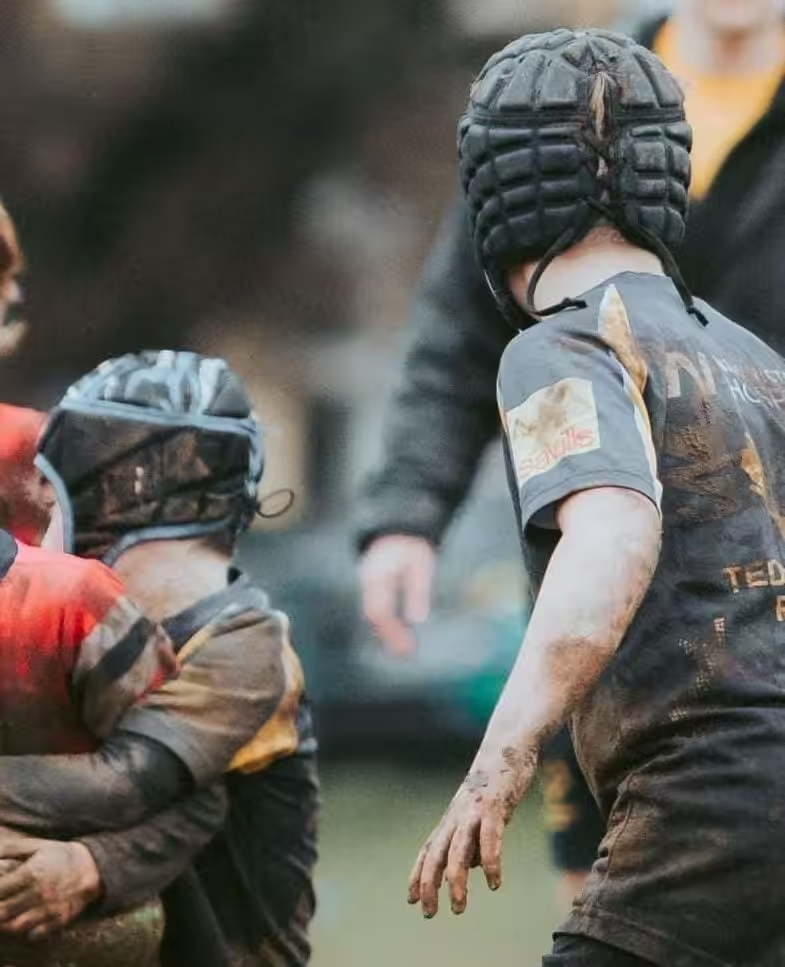
Traditional head protection has generally focused on protecting the scalp: cushioning an impact or reducing superficial injuries.
Brain protection focuses on reducing the forces that cause the brain to rotate and deform inside the skull.
That is the category shift. An angled head impact can cause rotational acceleration even where the outside of the head is padded.
Brain protection therefore needs to address the biomechanics of brain injury, particularly rotational force transmission in concussive and sub-concussive impacts.
Read more: How brain protection technology works.
How Rezon Halos® Flag Football Headguard is Different
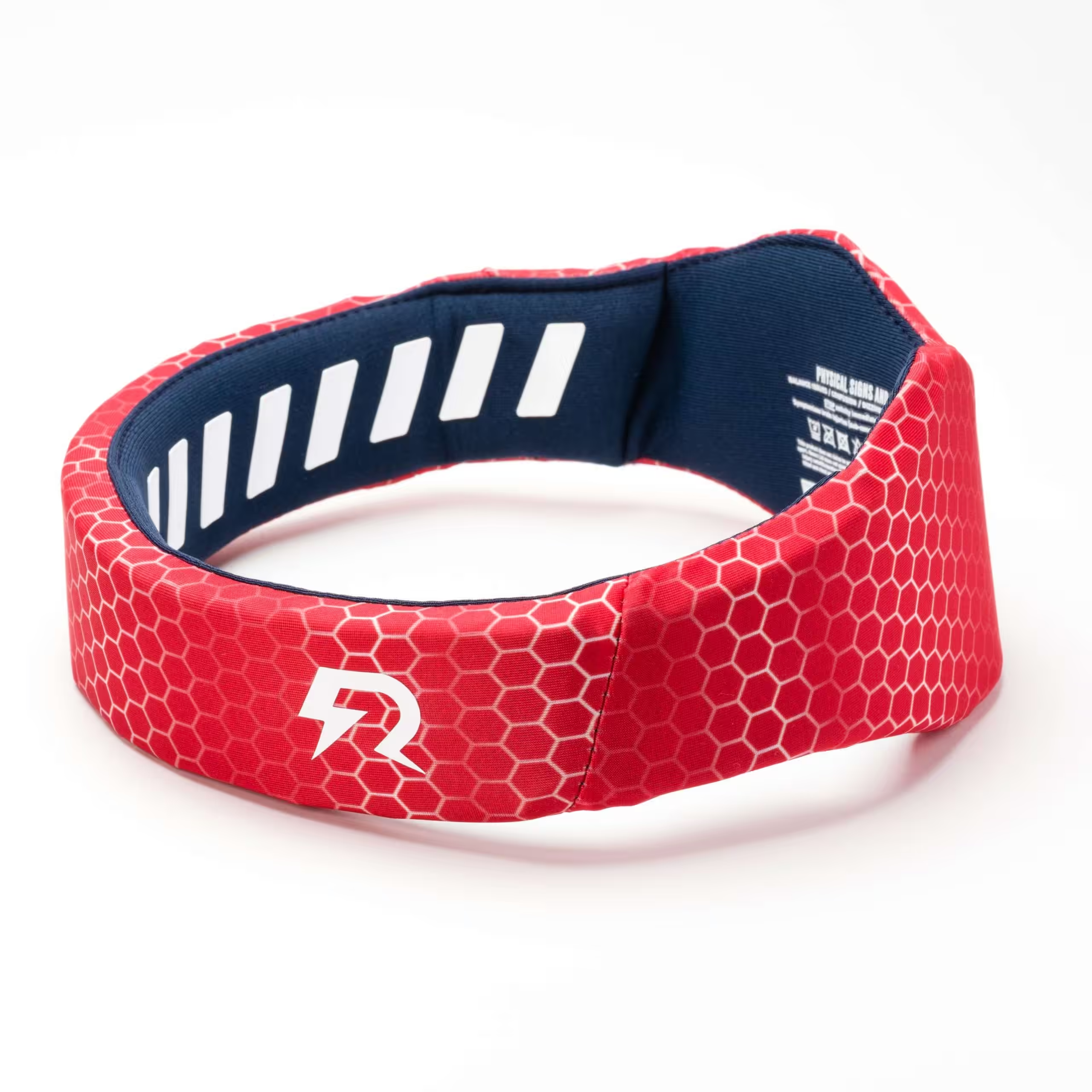
The Rezon Halos® Flag Football Headguard is brain protection.
It has been engineered specifically to reduce rotational force transmission during concussive and sub-concussive head impacts and reduce the accumulated damage from sub-concussions.
Halos® uses patented Rotection® technology, a multi-layered system designed to move independently from the head during impact and reduce the forces transmitted to the brain.
Why Halos®?
- reduces rotational force transmission by up to 61%;
- reduces linear force transmission by up to 64%;
- reduces concussion risk by 74%;
- Virginia Tech 5-star safety rated;
- CE and UKCA Category II PPE certified [11, 12, 13].
Flag football has already removed one major source of head-impact exposure by removing deliberate tackling. Rezon Halos® is designed to reduce the forces transmitted to the brain when the unavoidable impact still happens.

Can flag football ever be completely safe?
No sport involving speed, competition and unpredictable movement can be made completely risk-free, but flag football has already demonstrated that sport can evolve. By replacing tackling with flag pulling, it substantially reduces head-impact exposure compared with tackle football [1]. That is an important safety achievement.
The next step is to recognise the risk that remains. Players can still collide. They can still fall. They can still experience concussion. And they can still experience sub-concussive impacts that transmit rotational forces to the brain without producing symptoms.
The realistic goal should not be to remove children and adults from a sport they enjoy. It should be to reduce avoidable brain injury risk wherever possible through brain protection designed around the biomechanics of brain injury.
Flag football has already taken a major step towards reducing head-impact exposure. Brain protection can take that principle further.
Frequently Asked Questions
- Head Impact Exposures Among Youth Tackle and Flag American Football Athletes. Waltzman D, Sarmiento K, Devine O, et al. Sports Health. 2021
- Flag Football – Olympic Games Los Angeles 2028
- Epidemiology of Injuries in National Collegiate Athletic Association Women’s Field Hockey: 2014–2015 Through 2018–2019. Nedimyer AK, Chandran A, Hirschorn RM, et al. Journal of Athletic Training. 2021.
- Epidemiologic Measures for Quantifying the Incidence of Concussion in National Collegiate Athletic Association Sports. Kerr ZY, Chandran A, Nedimyer AK, et al. Journal of Athletic Training. 2017.
- Match and training injury epidemiology in elite UK netball: a prospective cohort study over one season. Horne S, Shaheen AF, Baltzopoulos B, Hills L. BMJ Open Sport & Exercise Medicine. 2025.
- Sex- and Age-Specific Review of Flag Football Injuries in the United States. Locke AR, et al. Sports Health. 2025.
- Biomechanics of Concussion. Meaney DF, Smith DH. Clinics in Sports Medicine. 2011.
- Mechanical disruption of the blood–brain barrier following experimental concussion. Johnson VE, Weber MT, Xiao R, et al. Acta Neuropathologica. 2018.
- Subconcussive Head Impact Exposure and White Matter Tract Changes over a Single Season of Youth Football. Bahrami N, et al. Radiology, 2016.
- CTE: The silent killer in contact sports. Dr Emer MacSweeney. TEDx Athens.
- Virginia Tech Helmet Ratings.
- Virginia Tech Soccer Ratings.
- Independent Laboratory Testing for Rezon Halos®.
Author: Alex Reily